What Combivir is and what it is used for
Combivir is used to treat HIV (human immunodeficiency virus) infection in adults and children.
Combivir contains two active ingredients that are used to treat HIV infection: lamivudine and zidovudine. Both of these belong to a group of anti-retroviral medicines called nucleoside analogue reverse transcriptase inhibitors (NRTIs).
Combivir does not completely cure HIV infection; it reduces the amount of virus in your body, and keeps it at a low level. It also increases the CD4 cell count in your blood. CD4 cells are a type of white blood cells that are important in helping your body to fight infection.
Not everyone responds to treatment with Combivir in the same way. Your doctor will monitor the effectiveness of your treatment.
Before you take Combivir
Don't take Combivir:
- if you're allergic (hypersensitive) to lamivudine or zidovudine, or any of the other ingredients of Combivir tablets (listed in section 6)
- if you have a very low red blood cell count (anaemia) or a very low white blood cell count (neutropenia).
Check with your doctor if you think any of these apply to you.
Take special care with Combivir
Some people taking Combivir or other combination treatments for HIV are more at risk of serious side effects. You need to be aware of the extra risks:
- if you have ever had liver disease, including hepatitis B or C (if you have hepatitis B infection, don't stop Combivir without your doctor's advice, as your hepatitis may come back)
- if you have kidney disease
- if you are seriously overweight (especially if you're a woman)
- if you're diabetic and using insulin.
Talk to your doctor if any of these apply to you. Your doctor will decide if the active substances are suitable for you. You may need extra check-ups, including blood tests, while you're taking your medicine. See Section 4 for more information.
Look out for important symptoms
Some people taking medicines for HIV infection develop other conditions, which can be serious. You need to know about important signs and symptoms to look out for while you're taking Combivir.
Protect other people
HIV infection is spread by sexual contact with someone who has the infection, or by transfer of infected blood (for example, by sharing injection needles). Combivir will not stop you passing HIV infection on to other people. To protect other people from becoming infected with HIV:
Use a condom when you have oral or penetrative sex.
Don't risk blood transfer - for example, don't share needles.
Other medicines and Combivir
Tell your doctor or pharmacist if you're taking any other medicines, or if you've taken any recently, including herbal medicines or other medicines you bought without a prescription.
Remember to tell your doctor or pharmacist if you begin taking a new medicine while you're taking Combivir.
These medicines should not be used with Combivir:
- stavudine or zalcitabine, to treat HIV infection
- ribavirin, or injections of ganciclovir or foscarnet to treat viral infections
- high doses of co-trimoxazole, an antibiotic.
Tell your doctor if you're being treated with any of these.
Some medicines can make it more likely that you'll have side effects, or make side effects worse.
These include:
- sodium valproate, to treat epilepsy
- interferon, to treat viral infections
- pyrimethamine, to treat malaria and other parasitic infections
- dapsone, to prevent pneumonia and treat skin infections
- fluconazole or flucytosine, to treat fungal infections such as Candida
- pentamidine or atovaquone to treat parasitic infections such as PCP
- amphotericin or co-trimoxazole, to treat fungal and bacterial infections
- probenecid, to treat gout and similar conditions, and given with some antibiotics to make them more effective
- methadone, used as a heroin substitute
- vincristine, vinblastine or doxorubicin, to treat cancer.
Tell your doctor if you're taking any of these.
Some medicines interact with Combivir
These include:
- clarithromycin, an antibiotic. If you're taking clarithromycin, take your dose at least 2 hours before or after you take your Combivir.
- phenytoin, for treating epilepsy.
Tell your doctor if you're taking phenytoin. Your doctor may need to monitor you while you're taking Combivir.
Pregnancy
If you are pregnant, if you become pregnant or if you are planning to become pregnant talk to your doctor about the risks and benefits to you and your baby of taking Combivir.
Combivir and similar medicines may cause side effects in unborn babies. If you become pregnant while you're taking Combivir, your baby may be given extra check-ups (including blood tests) to make sure it is developing normally.
Children whose mothers took NRTIs (medicines like Combivir) during pregnancy had a reduced risk of being infected with HIV. This benefit is greater than the risk of having side effects.
Breast-feeding
Women who are HIV-positive must not breast-feed, because HIV infection can be passed on to the baby in breast milk.
If you're breast-feeding or thinking about breast-feeding:
Talk to your doctor immediately.
Driving and using machines
Combivir can make you dizzy and have other side effects that make you less alert. Don't drive or operate machines unless you're feeling well.
How to take Combivir
Always take Combivir exactly as your doctor has told you to. Check with your doctor or pharmacist if you're not sure.
Swallow Combivir tablets, with some water. Combivir can be taken with or without food.
If you cannot swallow the tablets whole, you may crush and combine them with a small amount of food or drink, and take all the dose immediately.
Stay in regular contact with your doctor.
Combivir helps to control your condition. You need to keep taking it every day to stop your illness getting worse. You may still develop other infections and illnesses linked to HIV infection.
Keep in touch with your doctor, and don't stop taking Combivir without your doctor's advice.
How much to take
Adults and adolescents 30 kg or more
The usual dose of Combivir is one tablet twice a day.
Take the tablets at regular times, leaving approximately 12 hours between each tablet.
Children who weigh between 21 and 30 kg
The usual starting dose of Combivir is one half tablet taken in the morning and one whole tablet taken in the evening.
Children who weigh between 14 and 21 kg
The usual starting dose of Combivir is one half tablet taken in the morning and one half tablet taken in the evening.
For children who weigh less than 14 kg lamivudine and zidovudine (the ingredients of Combivir) should be taken separately.
If you take too much Combivir
If you accidentally take too much Combivir, tell your doctor or your pharmacist, or contact your nearest hospital emergency department for further advice.
If you forget to take Combivir
If you forget to take a dose, take it as soon as you remember. Then continue your treatment as before. Don't take a double dose to make up for a missed dose.
Possible side effects
Like all medicines, Combivir can cause side effects, but not everyone gets them.
When you're being treated for HIV, it can be hard to tell whether a symptom is a side effect of Combivir or other medicines you're taking, or an effect of the HIV disease itself. So it is very important to talk to your doctor about any changes in your health.
As well as the side effects listed below for Combivir, other conditions can develop during combination therapy for HIV. It is important to read the information later in this section under 'Other possible side effects of combination therapy for HIV.'
Very common side effects
These may affect more than 1 in 10 people:
- headache
- feeling sick (nausea).
Common side effects
These may affect up to 1 in 10 people:
- being sick (vomiting)
- diarrhoea
- stomach pains
- loss of appetite
- feeling dizzy
- tiredness, lack of energy
- fever (high temperature)
- general feeling of being unwell
- difficulty in sleeping (insomnia)
- muscle pain and discomfort
- joint pain
- cough
- irritated or runny nose
- skin rash
- hair loss (alopecia).
Common side effects that might show up in blood tests are:
- a low red blood cell count (anaemia) or low white blood cell count (neutropenia or leucopenia)
- an increase in the level of liver enzymes
- an increased amount in the blood of bilirubin (a substance produced in the liver) which may make your skin appear yellow.
Uncommon side effects
These may affect up to 1 in 100 people:
- feeling breathless
- wind (flatulence)
- itching
- muscle weakness.
An uncommon side effect that may show up in blood test is:
- a decrease in the number of cells involved in blood clotting (thrombocytopenia) or in all kinds of blood cells (pancytopenia).
Rare side effects
These may affect up to 1 in 1000 people:
- serious allergic reaction causing swelling of the face, tongue or throat which may cause difficulty in swallowing or breathing
- liver disorders, such as jaundice, enlarged liver or fatty liver, inflammation (hepatitis)
- lactic acidosis (see the next section, 'Other possible side effects of combination therapy for HIV')
- inflammation of the pancreas (pancreatitis)
- chest pain; disease of the heart muscle (cardiomyopathy)
- fits (convulsions)
- feeling depressed or anxious, not being able to concentrate, feeling drowsy
- indigestion, taste disturbance
- changes in the colour of your nails, your skin or the skin inside your mouth
- a flu-like feeling - chills and sweating
- tingly feelings in the skin (pins and needles)
- sensation of weakness in the limbs
- breakdown of muscle tissue
- numbness
- passing urine more often
- enlarged breasts in men.
Rare side effects that may show up in blood tests are:
- an increase in an enzyme called amylase
- a failure of the bone marrow to produce new red blood cells (pure red cell aplasia).
Very rare side effects
These may affect up to 1 in 10,000 people:
A very rare side effect that may show up in blood tests is:
- a failure of the bone marrow to produce new red or white blood cells (aplastic anaemia).
If you get side effects
Tell your doctor or pharmacist if any of the side effects get severe or troublesome, or if you notice any side effects not listed in this leaflet.
Other possible side effects of combination therapy for HIV
Combination therapy such as Combivir may cause other conditions to develop during HIV treatment.
Old infections may flare up
People with advanced HIV infection (AIDS) have weak immune systems, and are more likely to develop serious infections (opportunistic infections). When these people start treatment, they may find that old, hidden infections flare up, causing signs and symptoms of inflammation. These symptoms are probably caused by the body's immune system becoming stronger, so that the body starts to fight these infections. If you get any symptoms of infection while you're taking Combivir:
Tell your doctor immediately. Don't take other medicines for the infection without your doctor's advice.
Your body shape may change
People taking combination therapy for HIV may find that their body shape changes, because of changes in fat distribution:
Fat may be lost from the legs, arms or face.
Extra fat may build up around the tummy (abdomen), or on the breasts or internal organs.
Fatty lumps (sometimes called buffalo hump) may appear on the back of the neck.
It is not yet known what causes these changes, or whether they have any long-term effects on your health. If you notice changes in your body shape: tell your doctor.
Lactic acidosis is a rare but serious side effect
Some people taking Combivir, or other medicines like it (NRTIs), develop a condition called lactic acidosis, together with an enlarged liver.
Lactic acidosis is caused by a build up of lactic acid in the body. It is rare; if it happens, it usually develops after a few months of treatment. It can be life-threatening, causing failure of internal organs. Lactic acidosis is more likely to develop in people who have liver disease, or in obese (very overweight) people, especially women.
Signs of lactic acidosis include:
- deep, rapid, difficult breathing
- drowsiness
- numbness or weakness in the limbs
- feeling sick (nausea), being sick (vomiting)
- stomach pain.
During your treatment, your doctor will monitor you for signs of lactic acidosis. If you have any of the symptoms listed above, or any other symptoms that worry you:
See your doctor as soon as possible.
You may have problems with your bones
Some people taking combination therapy for HIV develop a condition called osteonecrosis. With this condition, parts of the bone tissue die because of reduced blood supply to the bone. People may be more likely to get this condition:
- if they have been taking combination therapy for a long time
- if they are also taking anti-inflammatory medicines called corticosteroids
- if they drink alcohol
- if their immune systems are very weak
- if they are overweight.
Signs of osteonecrosis include:
- stiffness in the joints
- aches and pains (especially in the hip, knee or shoulder)
- difficulty moving.
If you notice any of these symptoms: tell your doctor.
Other effects may show up in blood tests
Combination therapy for HIV can also cause:
- increased levels of lactic acid in the blood, which on rare occasions can lead to lactic acidosis
- increased levels of sugar and fats (triglycerides and cholesterol) in the blood
- resistance to insulin (so if you're diabetic, you may have to change your insulin dose to control your blood sugar).
How to store Combivir
Keep Combivir out of the reach and sight of children.
Do not take Combivir after the expiry date shown on the carton.
Do not store above 30°C.
If you have any unwanted Combivir tablets, don't dispose of them in your waste water or your household rubbish. Ask your pharmacist how to dispose of medicines no longer required. These measures will help to protect the environment.
Further information
What Combivir contains
The active substances are lamivudine and zidovudine. The other ingredients are:
- tablet core: microcrystalline cellulose, sodium starch glycollate (gluten free), magnesium stearate, colloidal silicon dioxide
- tablet film-coat: hypromellose, titanium dioxide, macrogol 400 and polysorbate 80.
What Combivir looks like and contents of the pack
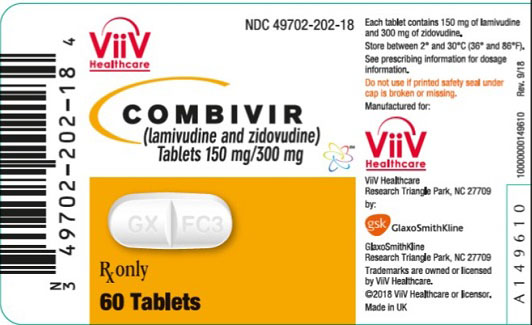
Combivir film-coated tablets are provided in tamper evident blister packs containing 60 tablets. They are white to off-white, capsule-shaped scored tablets marked with the code GXFC3 on both sides.