



Diphyllobothrium Latum Infection

Essentials of Diagnosis
- Stool examination reveals ovoid, yellow-brown eggs (60-75 µm by 40-50 µm).
- Chains of proglottids (up to 50 cm long) may be passed in stool.
- Proglottids are wider than long (3 by 11 mm).
- Scolex has no hooklets and two grooves (bothria).
- Gravid proglottid contains rosette-shaped central uterus.
General Considerations
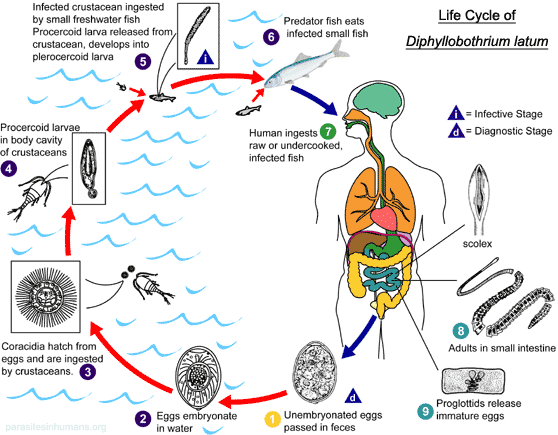
D latum is found worldwide, and infection is acquired by ingestion of contaminated raw or improperly cooked freshwater fish. Because of enthusiasm for raw or undercooked fish, Siberia, Europe, Canada, Alaska, and Japan are endemic regions for D latum infection. Once the D latum cyst has been ingested, the worm matures within the human intestine and begins to produce eggs after 5 weeks. A mature D latum may reach lengths of several meters and contain about 30,000 proglottids.
Eggs and proglottids that are passed in stool hatch after 14 days in fresh water into ciliated coracidium larvae, which are ingested by the intermediate host, the aquatic copepod. Inside the copepod, the larvae develop into a second larval form, the procercoid. Once the copepod is ingested by a freshwater fish, the procercoid larva matures into the plerocercoid larva, which may encyst within fish tissues. Human ingestion of improperly prepared fish initiates infection by the plerocercoid larva cyst. Bears, seals, cats, mink, foxes, and wolves are alternate definitive hosts for D latum.
Clinical Findings
Signs and Symptoms
Infection with D latum is most often asymptomatic, but symptoms such as bloating, abdominal pain, or diarrhea may be present. More rarely, intestinal obstruction may occur. A rare complication of chronic small-intestinal involvement with D latum is the development of vitamin B12 deficiency, characterized by anemia with or without neurologic sequelae. This syndrome occurs most often in patients with a genetic predisposition to the development of pernicious anemia, commonly people of Scandinavia. Patients with unexplained anemia or neurologic symptoms and a history of raw freshwater fish consumption should be evaluated carefully.
Laboratory Findings
Frequently the only abnormal finding in a patient infected with D latum is the presence of eggs or proglottids on examination of stool for ova and parasites. Blood examination may reveal a slight leukocytosis with eosinophilia and occasionally a megaloblastic anemia associated with vitamin B12 deficiency.
Imaging
Contrast studies of the gastrointestinal tract may reveal ribbonlike filling defects corresponding to the adult worm.
Differential Diagnosis
The most usual manifestation of D latum infection is asymptomatic carriage, which is incidentally discovered. If patients present with abdominal pain and diarrhea, the differential diagnosis includes a variety of infectious and noninfectious causes. Diarrhea from D latum infection will not be associated with stool leukocytes; this aids in formulating a differential diagnosis. Noninfectious etiologies to consider include osmotic (eg, lactose intolerance) and secretory (eg, villous adenoma) etiologies, malabsorption syndromes (eg, celiac sprue), and motility disorders (eg, irritable bowel syndrome). Infectious etiologies causing diarrhea without stool leukocytes include rotavirus, Norwalk virus, Giardia lamblia, Entamoeba histolytica, Cryptosporidium spp., and toxigenic diarrhea caused by Staphylococcus aureus, Bacillus cereus, Clostridium perfringens, and enterotoxigenic Escherichia coli.
| Aspect | Findings and notes | Examples |
|---|---|---|
| Transmission and exposure | Ingestion of raw or undercooked freshwater fish in endemic regions | Siberia, Europe, Canada, Alaska, Japan; consumption of contaminated fish |
| Intestinal manifestations | Often asymptomatic; may cause mild to moderate gastrointestinal complaints | Bloating, abdominal pain, diarrhea; rare intestinal obstruction |
| Hematologic manifestations | Interference with vitamin B12-intrinsic factor complex, leading to deficiency in some patients | Megaloblastic anemia, especially in individuals predisposed to pernicious anemia |
| Neurologic manifestations | Related to long-standing vitamin B12 deficiency | Peripheral neuropathy, cognitive changes, possible posterior column involvement |
| Laboratory findings | Eggs or proglottids on stool examination; mild blood count abnormalities | Ovoid yellow-brown eggs; slight leukocytosis with eosinophilia; anemia in deficient patients |
| Imaging findings | Noninvasive visualization of the adult worm in the intestine | Ribbonlike filling defects on contrast gastrointestinal studies |
| Prevention and follow-up | Safe fish preparation and post-treatment monitoring | Thorough cooking or proper freezing of freshwater fish; follow-up stool examinations; evaluation of vitamin B12 status when indicated |
Complications
The complications vary with the clinical syndrome associated with infection. Chronic diarrhea may lead to malnutrition. Megaloblastic anemia secondary to vitamin B12 deficiency results when the parasite disrupts the vitamin B12-intrinsic factor complex, resulting in vitamin B12 becoming unavailable for absorption by the host. Vitamin B12 deficiency may lead to neurologic sequelae including peripheral neuropathy, dementia, and possible severe combined degeneration of the posterior columns. Also, infection with D latum may rarely result in intestinal obstruction caused by a mass of entangled worms.
Early recognition of anemia and neurologic changes is important, since timely treatment of the infection and correction of vitamin B12 deficiency can prevent or limit permanent neurologic damage.
Treatment
Therapy for infection with D latum consists of either praziquantel or niclosamide. Follow-up examinations of stool should be performed 1 and 3 months after treatment to document clearance of the parasite. Drug selection and dosing are individualized and should follow established clinical guidance.
Prognosis
Since the disease is not commonly associated with severe symptoms, the prognosis of infected individuals is excellent. One exception is in patients who manifest vitamin B12 deficiency, in whom the neurologic complications are reversible only if recognized and treated early.
Prevention & Control
Prevention of infection from D latum is achieved through adequate cooking of all freshwater fish or freezing of fish for 24-48 hours at about 0 °F (-18 °C). Isolation of infected persons is not required. Public health measures that promote safe handling and preparation of freshwater fish in endemic areas can further reduce transmission.