



Classification of Antiretroviral Agents

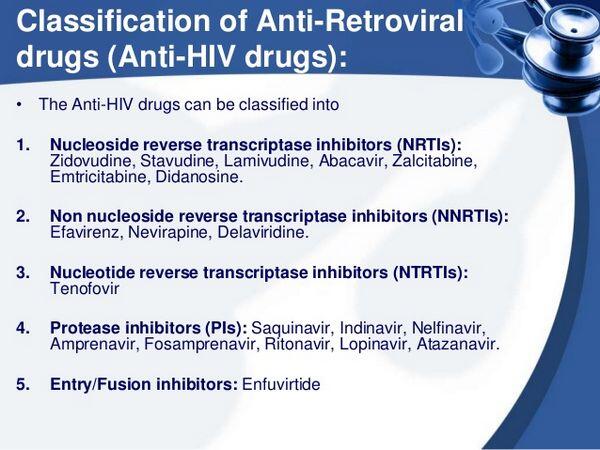
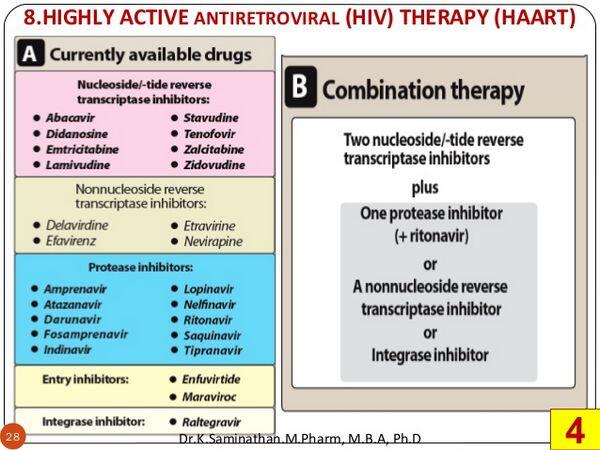
Antiretroviral agents are synthetic antiviral agents that have antiviral activity against human immunodeficiency virus (HIV) and are used in the management of HIV infection. There currently are five different classes of antiretroviral agents commercially available: nucleoside reverse transcriptase inhibitors (NRTIs), HIV protease inhibitors, nonnucleoside reverse transcriptase inhibitors (NNRTIs), nucleotide reverse transcriptase inhibitors, and HIV fusion inhibitors. These agents are often used in combination to suppress viral replication and reduce the risk of resistance.
| Class | Abbreviation | Representative agents | Primary target |
|---|---|---|---|
| Nucleoside reverse transcriptase inhibitors | NRTIs | Abacavir, zidovudine, lamivudine, stavudine | Reverse transcriptase (DNA chain termination) |
| HIV protease inhibitors | - | Indinavir, ritonavir, saquinavir, lopinavir | HIV protease (virion maturation) |
| Nonnucleoside reverse transcriptase inhibitors | NNRTIs | Delavirdine, efavirenz, nevirapine | Reverse transcriptase (allosteric inhibition) |
| Nucleotide reverse transcriptase inhibitors | - | Tenofovir disoproxil fumarate | Reverse transcriptase (DNA chain termination) |
| HIV fusion inhibitors | - | Enfuvirtide | Viral entry and fusion |
Nucleoside reverse transcriptase inhibitors
- abacavir sulfate (ABC)
- didanosine (ddI)
- emtricitabine (FTC)
- lamivudine (3TC)
- stavudine (dT)
- zalcitabine (ddC)
- zidovudine (ZDV, AZT)
NRTIs are synthetic analogs of naturally occurring nucleosides. There currently are seven NRTIs commercially available. The drugs have a wider spectrum of antiviral activity than other currently available antiretroviral agents, and NRTIs are active in vitro against human retroviruses, including HIV type 1 (HIV-1) and HIV type 2 (HIV-2). In addition, abacavir, didanosine, zalcitabine, and zidovudine are active against many animal retroviruses, including feline leukemia virus, Friend leukemia virus, Harvey murine sarcoma virus, murine leukemia virus, and simian T lymphotropic virus. Abacavir, didanosine, lamivudine, zalcitabine, and zidovudine have some activity against hepatitis B virus; however, NRTIs generally have been inactive against other human or animal viruses tested, including herpes simplex virus types 1 and 2, influenza virus, adenovirus, cytomegalovirus, respiratory syncytial virus, varicella-zoster virus, and vaccinia virus.
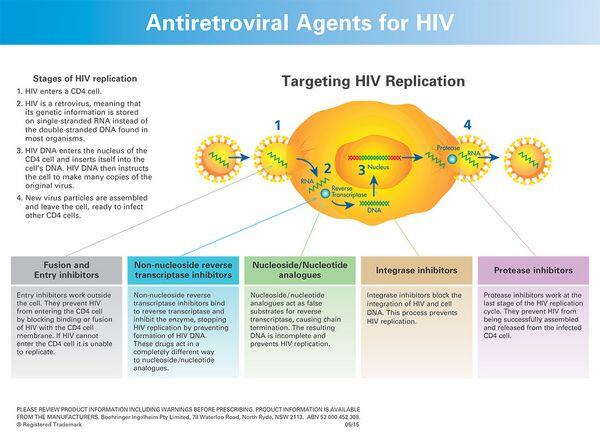
NRTIs are inactive until phosphorylated by cellular enzymes and converted into active triphosphate metabolites. The pharmacologically active triphosphate metabolites then compete with naturally occurring deoxynucleoside triphosphates for the active binding site on viral reverse transcriptase, an enzyme essential for viral replication. Once the triphosphate metabolites become incorporated into viral DNA, synthesis of the viral DNA chain is terminated since the metabolites lack a functional 3-hydroxyl group, preventing further 5 to 3 phosphodiester linkages. This chain termination effect is central to their antiviral activity.
HIV protease inhibitors
- amprenavir (VX-478)
- atazanavir sulfate (ATV)
- fosamprenavir calcium
- indinavir sulfate (IDV, MK-639)
- lopinavir and ritonavir (ABT-378/r)
- nelfinavir mesylate (AG1343)
- ritonavir (RTV, ABT-538)
- saquinavir (SQV, RO 31-8959)
HIV protease inhibitors are synthetic antiviral agents that were specifically designed based on the structure of HIV protease, an enzyme that plays an essential role in the HIV replication cycle. Using computer models of the enzyme and binding sites on the enzyme, a wide variety of compounds have been identified as potential inhibitors of HIV protease activity. There currently are eight HIV protease inhibitors commercially available and many more under investigation.
HIV protease inhibitors have a very limited spectrum of activity. The drugs are active against HIV-1 and some (but not all) are active to a lesser extent against HIV-2. While indinavir and saquinavir have some activity against simian immunodeficiency virus, HIV protease inhibitors generally have been inactive against other human and animal viruses tested. On a molar basis, HIV protease inhibitors appear to be more active than either NRTIs or NNRTIs against susceptible HIV-1.
Currently available HIV protease inhibitors have similar mechanisms of action. The drugs inhibit replication of HIV-1 and HIV-2 by directly interfering with HIV protease activity. The result is the formation of noninfectious immature virions. Most of the drugs function as selective, competitive, reversible inhibitors of the enzyme. Unlike NRTIs, the antiretroviral activity of most HIV protease inhibitors does not depend on intracellular conversion to an active metabolite. Because of their potency, these agents are key components of many combination regimens.
Nonnucleoside reverse transcriptase inhibitors
- delavirdine mesylate (DLV)
- efavirenz (EFV, DMP 266)
- nevirapine (NVP)
NNRTIs are a group of structurally diverse antiretroviral agents that have a similar mechanism of action. There currently are three NNRTIs commercially available and many more under investigation.
NNRTIs have a very specific spectrum of activity. Currently available NNRTIs are active against HIV-1, but are inactive against HIV-2 and also have been inactive against all other human or animal viruses tested to date.
NNRTIs inhibit replication of HIV-1 by interfering with viral RNA- and DNA-directed polymerase activities of reverse transcriptase. The mechanism of action of NNRTIs differs from that of NRTIs. While these other agents interfere with reverse transcriptase activity by becoming incorporated into the growing viral DNA chain, NNRTIs interfere with the function of reverse transcriptase by binding directly to the enzyme in a noncompetitive fashion. Unlike the NRTIs, the antiretroviral activity of HIV NNRTIs does not depend on intracellular conversion to an active metabolite. This distinction has important implications for resistance patterns and combination therapy.
Nucleotide reverse transcriptase inhibitors
- tenofovir disoproxil fumarate
Nucleotide reverse transcriptase inhibitors are a group of acyclic nucleoside phosphonates that have a similar mechanism of action. Tenofovir disoproxil fumarate currently is the only nucleotide reverse transcriptase inhibitor commercially available, but others are under investigation. For purposes of therapeutic decisions, tenofovir is grouped with the NRTI class of antiretroviral agents.
Tenofovir disoproxil fumarate is inactive until hydrolyzed in vivo to tenofovir and then phosphorylated by cellular enzymes and converted into tenofovir diphosphate. The diphosphate competes with naturally occurring deoxyadenosine triphosphate and, after incorporation into viral DNA, synthesis of the viral DNA chain is terminated. This mechanism closely parallels that of other reverse transcriptase chain terminators.
HIV fusion inhibitors
- enfuvirtide (T-20)
HIV fusion inhibitors are synthetic antiviral agents that interfere with the fusion of HIV-1 to its target cell. Enfuvirtide currently is the only HIV fusion inhibitor commercially available, but others are under investigation.
HIV fusion inhibitors have a very specific spectrum of activity. HIV fusion inhibitors are active against HIV-1, but are inactive against HIV-2.
HIV fusion inhibitors interfere with entry of HIV-1 into target cells by blocking conformational changes in the HIV-1 glycoprotein that are required for fusion of the virus to the membrane of the host CD4+ T-cell. By preventing this fusion step, these agents help to block the initial stages of viral infection of new cells.
| Class | Need for intracellular activation | Type of inhibition | Typical spectrum |
|---|---|---|---|
| NRTIs | Require phosphorylation to active triphosphate | Chain termination at reverse transcriptase | HIV-1 and HIV-2; some activity against hepatitis B virus |
| HIV protease inhibitors | No conversion to active metabolite required | Competitive inhibition of HIV protease | HIV-1; some agents active against HIV-2 |
| NNRTIs | No conversion to active metabolite required | Noncompetitive binding to reverse transcriptase | HIV-1 only |
| Nucleotide reverse transcriptase inhibitors | Hydrolysis and phosphorylation to active diphosphate | Chain termination at reverse transcriptase | HIV-1 and HIV-2 |
| HIV fusion inhibitors | No conversion to active metabolite required | Block fusion and entry into CD4+ T-cells | HIV-1 only |